Excision removes tissue instead of burning or freezing it. That detail matters if tissue should be preserved.
Excision removes the entire lesion and can keep a sample if analysis is indicated.
A broad base or thick lesion is less suited to destructive treatments.
The physician chooses sutures or guided healing according to skin tension.


Excision near the eye begins with anatomical landmarks. The physician checks distance from the lashes, eyelid margin, and tear duct opening.
A lesion against these structures is not treated like a skin tag on the neck. The physician may prefer oculoplastics referral if the margin is too small.
The goal is to remove only what can be removed cautiously. Closure accounts for skin tension and natural eyelid movement.
Excision mainly concerns broader, more fibrous, recurrent, or sample-worthy skin tags.
Eyelid skin tag with a broad base or attachment that is hard to target.
Thick lesion or fibrous tissue, less suited to cold treatment or radiofrequency.
Possible need for analysis if the physician wants to keep a tissue sample.
Mechanical irritation during blinking, makeup, or cleaning of the eyelid.
Recurrent skin tag after destructive treatment or incomplete removal.
Some lesions require referral, postponement, or medical discussion before any incision.
Suspected skin cancer — dermatology or oculoplastics referral first.
Lesion against the eyelid margin, tear duct opening, or lashes.
Active infection, open wound, or significant inflammation on the eyelid.
Blood thinners or unstable clotting disorder — risk of bleeding.
Keloid scars or known hypertrophic scars.
The session follows a clear sequence: confirm, numb, remove, close, then protect the area during healing.
She checks color, base, lashes, recent changes, and signs that require referral.
Under local anesthesia, the physician removes the lesion and its base with a measured gesture.
The physician chooses sutures or guided healing according to skin tension and location.
THE CARE EXPERIENCE
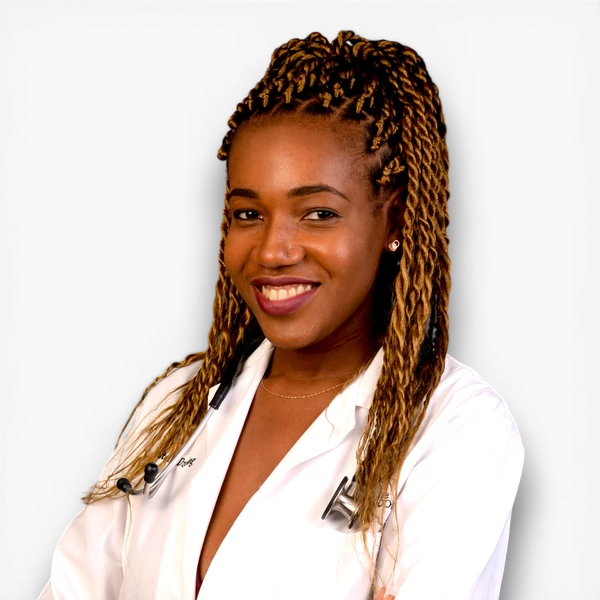
Family doctor and graduate of the Université de Montréal, in good standing with the Collège des médecins du Québec (CMQ), Dr. Karen Dzolang serves as medical director for the CARE network. For eyelid lesions and skin plaques near the eye, she helps frame the evaluation, possible indications, treatment limits and situations where another medical opinion is preferable.